|
|
|
You can get e-magazine links on WhatsApp. Click here
|
|
|
|
|
|
Yoghurt Based Composite Dairy Products: Cornucopia of Functional Properties
|
|
Tuesday, 05 March, 2019, 08 : 00 AM [IST]
|
|
Venus Bansal, Rekha Chawla, Sivakumar S, Nitika Go
|
Food is an essential part of human diet to stay fit and healthy. Balanced diet that provides all the basic nutrients in correct quantities is essential to maintain good health. However, no single food contains all the essential nutrients required for the body. Therefore, eating food from each of six groups i.e., grains, vegetables, fruits, milk products, meat and beans is important for prevention and treatment of diseases.
But the issue is that there is a drastic change in the eating habits of people. The lack of time has caused the change in diet structure of the people which has led to two prolonged nutritional problems; one emerging from excess and other from deficiency (Sharma and Garg, 2013).
To cater to the nutritional deficiency problems, food nutritionists and researchers are combining different food products to eliminate the deficiency or one or more micronutrient absent in one or the other group. Yoghurt-based composite dairy products is gaining particular interest of researchers as well as consumers owing to inherent nutritional benefits and grab-and-go characteristics.
Yoghurt is a fermented nutrient dense milk product obtained by coagulating milk with thermophilic starter culture consisting of Streptococcus thermophilus and Lactobacills delbruckii subsp. bulgaricus. On the basis of physical properties, yoghurt can be categorised into set, stirred and drinking yoghurt depending upon their end use and consistency (Tamime & Robbinson, 1999).
The concept to combine yoghurt with other food ingredients to enhance the flavour and nutritional value started way back in 1950s. A method of making fruit yogurt was patented by John et al. (1961). Since 1950s, many researchers have combined yoghurt with other food ingredients to enhance the nutritional value or to increase therapeutic value of yoghurt.
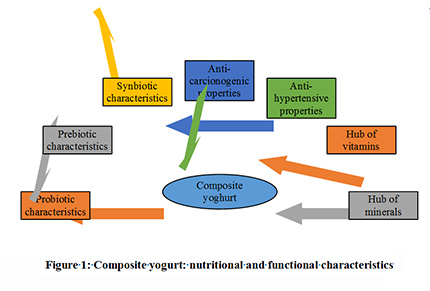
Nutritional and health benefits Yoghurt is enriched source of milk nutrients viz., fat, protein, calcium, magnesium, vitamin B-12, vitamin D and riboflavin. It is an excellent source of calcium which provides 41% of the recommended daily requirement of calcium for a 5-year-old through a serving of 50 g of yoghurt. Yoghurt is also considered safe to consume for the lactose-intolerant people. Apart from nutritional benefits, yoghurt is considered to have therapeutic benefits as well.
Combining yoghurt with fruits, vegetables and grains enhances the nutritional value with added health benefits. Fruits and vegetables are very good source of dietary fibre, antioxidants and phenolic compounds that possess the functional properties. Combining yoghurt with foods rich in fibre content reduces the risk of gastrointestinal diseases, cardiovascular disease and certain cancers (Fernandez and Marette, 2017). Combining yoghurt with foods that are rich in polyphenol and antioxidant content has been reported to have beneficial effects on hypertension, cardiovascular diseases, cancer, obesity and inflammation (Rodriguez-Casado, 2016).
 Technological challenges
The addition of fruits and vegetables to yoghurt may alter the sensory and textural properties of yoghurt. The food rich in fibres may improve the rheological properties of yoghurt while food rich in phenolic compounds may adversely affect the properties of yoghurt. The concentration gradient between fruit pieces, milk gel, aqueous bulk phase and the fat globule are driving force for transfer of small analytes from one phase to another (Nongonierma et al., 2007) which effects the sensorial properties of yoghurt.
The interaction of phenolic compounds with hydrophobic surface of milk protein reduces the number of available hydrophobic functional group which reduces the water binding capacity of proteins and thus increases the wheying off in yogurt. Therefore, it is very important to standardise the technology of composite yoghurt that has superior sensory properties with enhanced nutritional value.
Table 1: Effect of addition of fruits and vegetables on sensory and textural properties of yoghurt
|
Composite
yoghurt
type
|
Food
ingredients
used
|
Concentration
|
Outcome
|
Reference
|
|
Stirred
fruit yoghurt
|
Passion
fruit fibre
|
1%
|
No
effect on sensory attributes, increase in apparent viscosity and
strength of yoghurt
structure
|
Espirioto-Santo
et
al. 2013
|
|
Set
fruit yoghurt
|
Papaya
and cactus pear pulp
|
5,
10 & 15%
|
Sensory
perception, water holding capacity and antioxidant activity
increased while decrease in syneresis was observed
|
Amal
et
al.
2016
|
|
Stirred
fruit yogurt
|
Cornelian,
Morello Chery and Rose hip marmalade, grape molasses, date pulp
|
7%
|
Yoghurt
containing date pulp and rosehip marmalade shows less syneresis
than controls
while the syneresis in other fruit yoghurts
was more than control
|
Tarakci
& Kucukoner, 2003
|
|
Set
fruit yoghurt
|
Banana,
papaya and water melon
|
5,
10 & 15%
|
Banana
yoghurt
shows least syneresis among all while papaya yoghurt
was more accepted to panelists
|
Roy
et
al.
2016
|
|
Fibre
supplemented yogurt
|
Fibres
from apple, wheat, bamboo and inulin
|
1.3%
|
Significant
effect of type of fibre
and storage time on rheological properties.
|
Staffolo
et
al. 2004
|
|
Yoghurt
supplemented with grape extract
|
Grape
extract
|
1.5
& 3 gL-1
|
Increase
in fermentation time and syneresis. No significant difference in
sensorial properties
|
Silva
et
al.
2017
|
As a conclusion, combining yoghurt with other food products will result in value addition with enhanced health benefits. The consumption of composite yoghurt will help to increase the intake of all the nutrients of concern. However, the fermentation of fruits and sugar added to yoghurt needs to be evaluated to study the effect on shelf life of the product. Moreover, the effect on bioavailability of micronutrients viz., minerals & vitamins with addition of other food products needs to be studied. Therefore, for further proliferation of these healthy products; an institutional-industrial partnership is required to develop and market these products at a wider scale. (Bansal, Chawla, Sivakumar , Goel and Khatkar are assistant professors at Department of Dairy Technology, College of Dairy Science & Technology, Guru Angad Dev Veterinary & Animal Sciences University. They can be contacted at venus3b3@gmail.com)
|
|
|
|
|
|
|
|
|
|