|
|
|
You can get e-magazine links on WhatsApp. Click here
|
|
|
|
|
|
Processing industry corpus under scrutiny as funds stagnate, fail to meet objective
|
|
Friday, 13 March, 2026, 08 : 00 AM [IST]
|
|
Ashwani Maindola, New Delhi
|
The corpus created by the Ministry of Finance for the food processing industry under the National Bank for Agriculture and Rural Development (NABARD) is under intense scrutiny following a 2025 Parliamentary Standing Committee report.
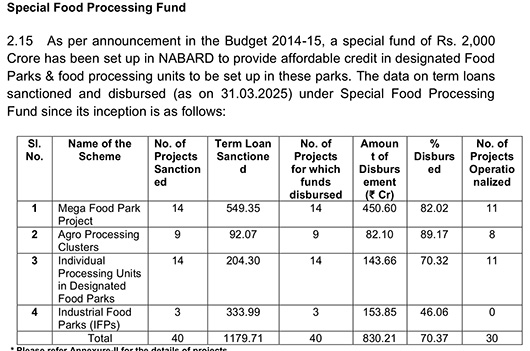
The report exposed that the Special Food Processing Fund (SFPF), established in 2014 with a ?2,000 crore corpus, has largely failed to meet its objective of providing affordable credit to the food processing sector.
As per the submission to the Parliamentary Committee as on March 31, 2025, a total of Rs.1179.71 cr has been sanctioned as term loan for 40 projects wherein only Rs. 820.21cr was disbursed.
The report, submitted to the Lok Sabha, highlights a significant disconnect between NABARD’s banking regulations and the ground realities of infrastructure development.
The most damning finding in the report is the mismatch in repayment timelines. Under RBI instructions, NABARD is required to repay deposits to commercial banks within 7 years, including a strict 2-year moratorium.
However, the committee noted that Mega Food Parks (MFPs) and Agro-Processing Clusters (APCs) typically require 3 to 5 years just to become operational. This rigid 2-year window has acted as a primary ‘hindrance’, effectively forcing projects into financial distress before they can even begin generating revenue.
The Ministry of Food Processing Industries (MoFPI) identified some critical reasons why NABARD’s fund has stagnated. The first reason remains ‘Timeline Mismatch’ as most of the 325 Designated Food Parks (DFPs) were established or had secured loans before the SFPF was even operational.
The second reason was ‘Operational Sluggishness’ wherein individual units within these parks are setting up at a snail’s pace owing to extended operational timelines for large-scale infrastructure.
The third reason was ‘Infrastructure Gaps, ’ which the ministry termed as ‘ lack of last-mile connectivity’ and the physical distance between 'Primary Processing Centres and Central Hubs' have made many projects unviable for the fund's credit terms.
And, lastly, the discontinuation of the Mega Food Park scheme in April 2021 further reduced the pool of eligible projects for the fund to support.
Meanwhile, in a bid to salvage the remaining corpus and improve project execution, NABARD has reportedly initiated two major corrective steps. One, NABARD has signed agreements with commercial banks to provide vital working capital to units already sanctioned under the fund, preventing them from stalling due to liquidity crunches and two, the bank is increasing the frequency of ‘Investor Meets’ to bridge the awareness gap among potential food park developers.
Although, without the RBI’s review of the terms and conditions of the loan, the NABARD fund is likely to remain just another scheme.
|
|
|
|
|
|
|
|
|
|