|
|
|
You can get e-magazine links on WhatsApp. Click here
|
|
|
|
|
|
Making HoReCa supply chains more robust
|
|
Friday, 26 June, 2026, 08 : 00 AM [IST]
|
|
Dr Prashant Sahni
|
The HoReCa (Hotels, Restaurants and Cafés/Catering) sector sits quietly behind many of our everyday food experiences. A full breakfast buffet that is ready before guests wake up, a café that never runs out of its signature pastry, or a banqueting hall serving hundreds of plates in a short service window: all of these depend on a supply chain that stays invisible when it works well, and painfully visible when it does not. At its core, the HoReCa supply chain covers everything that happens before food reaches the plate. It includes how ingredients, beverages, packaging, cleaning materials and small equipment are sourced, purchased, stored, delivered and tracked. It also includes the less visible decisions, who to buy from, how often to order, how much stock to hold, and how closely prices and contracts are monitored.
What makes the HoReCa chain different
Compared with retail, HoReCa operates with a different rhythm. Supermarkets plan around weekly or monthly purchase patterns; hotels and restaurants plan around meal periods, events, seasons and tourism flows. Orders are smaller and more frequent, and menus change far more often than retail assortments. A single distributor route might serve a luxury hotel, a small independent restaurant, a cloud kitchen and a catering unit on the same day, each with separate time windows and delivery conditions. This variety spills over into logistics. HoReCa supply chains routinely carry products at different temperatures viz frozen, chilled and ambient in the same trip. Maintaining product quality and food safety means not only reaching on time but also keeping each product in the right condition from warehouse to kitchen door. When a truck arrives late, when a key item is short-delivered, or when something arrives that does not match the kitchen’s specification, the stress immediately shows up in prep areas rather than in spreadsheets.
The role of suppliers, procurement and inventory
Suppliers and distributors are the structural backbone of this system. Beyond simply sharing price lists, strong relationships are built on dependable fill rates, clear communication during disruptions, consistent product quality and a willingness to solve problems when shortages occur. Procurement is where strategy meets daily practice. It decides which items are approved, which suppliers are preferred, what prices are negotiated and how orders are placed. When each location orders in its own way, without clear rules, small leakages slowly add up: different prices for the same item, frequent off-contract purchases, and substitutions that look harmless but quietly erode margins.
In contrast, standardised purchasing and disciplined adherence to contracts help control spend and reduce unpleasant surprises in monthly food-cost reviews. Inventory is another pressure point. Holding too much stock ties up cash and raises the risk of spoilage or obsolescence; holding too little leads to emergency buys, menu changes and stressed teams in the kitchen. Good inventory practice usually rests on simple but often neglected basics: regular and accurate stock counts, proper storage and rotation, clear responsibility for each store area, and ordering based on actual usage data instead of habit or rough guesses.
Why HoReCa supply chain management matters
The way the HoReCa supply chain is managed affects cost, consistency and day-to-day experience inside the operation. Food and supply costs are among the largest items in a restaurant or hotel P&L, so even small inefficiencies in pricing, ordering or waste can compound into significant margin loss over time. When supply chains are managed intentionally, operators can detect price drifts earlier, keep purchasing closer to plan, and protect margins without cutting quality.
From the guest’s perspective, supply chain reliability shows up as menu consistency. If ingredients are available on time and to specification, chefs can execute dishes as designed, night after night, across all outlets of a brand. This consistency builds trust with guests and reduces operational friction, particularly in multi-location chains where any variation in supply can quickly multiply into customer complaints. Waste is another area touched directly by supply chain decisions. Excessive ordering and poor forecasting lead to spoilage; chronic under-ordering leads to last-minute buying at higher prices and sometimes rushed preparation. Aligning ordering, inventory and menu planning helps reduce both waste and stock-outs.
Building stronger HoReCa supply chains
Experience from operators and industry analyses suggests several practices that make HoReCa supply chains more robust. Long-term, transparent relationships with key suppliers create room for joint problem-solving when disruptions appear, instead of transactional blame-shifting. Standardising procurement i.e. approved lists, clear contracts, common rules across locations can reduce variability and makes it easier to monitor compliance and cost.
Improving inventory accuracy through regular counts, clear storage rules and accountability helps teams order more intelligently and cut waste. Using actual sales history, seasonality and menu performance data to forecast demand supports more realistic ordering cycles and reduces last-minute panic buying. Diversifying suppliers for critical categories can provide a safety net if one source fails, while still keeping overall complexity manageable
Concepts such as Economic Order Quantity (EOQ) and reorder point help restaurants and hotels estimate the most economical order size by balancing ordering costs with holding costs, so that ingredients are replenished in sensible batches rather than by guesswork. For example, consider inventory of sausages sold in a restaurant. If you order too little, the kitchen runs out mid-service and cannot meet demand; if you over-order, excess stock sits in the freezer beyond its shelf life and spoils, creating waste and extra cost. EOQ and a calculated reorder point help you order just enough to keep the line running without loading the freezer with excess that will deteriorate.
Optimum inventory also slashes hidden costs. By avoiding over-stocking, you need less cold storage capacity, which means fewer refrigerators to install and fewer units to run. This reduces capital expenditure on equipment, as well as ongoing electricity, maintenance, and the operational burden of keeping multiple units at optimal temperatures. At a broader level, multi-echelon inventory optimisation looks at the entire network as one system and decides how much stock should sit at each level to meet service targets while minimising total inventory and waste.
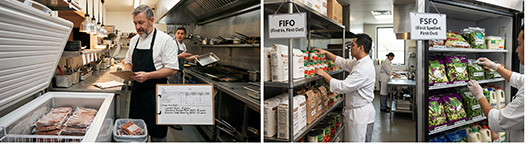
FIFO (First In, First Out) and FSFO (First Spoiled, First Out) reinforce the discipline along with food safety by ensuring that the oldest or earliest-expiring batches are used or sold first, and that items closest to spoilage are prioritised for use or removal, so that products move through the system in a logical sequence rather than piling up unnoticed at the back of the store. Equally important is aligning menu design with what the supply chain can reliably and affordably support. Menus that depend heavily on fragile, hard-to-source items or frequent one-off specials place continuous stress on procurement and logistics; menus designed with supply realities in mind are easier to execute consistently.
The growing role of technology
Digital tools are increasingly central to restaurant and HoReCa supply-chain management. Connected platforms can bring purchasing, inventory, price monitoring and reporting into a single view, instead of scattering them across files and emails. This visibility makes it easier to see where money is going, where contracts are slipping, and where savings or improvements are possible. Route-planning software, electronic proof of delivery and real-time tracking help distributors manage complex, multi-drop delivery routes and reduce errors on the last mile.
For multi-location brands, standardised operating procedures (SOPs) supported by shared systems allow central teams to guide procurement and inventory without micromanaging each unit. Over time, a more connected and data-driven HoReCa supply chain can move operators from a reactive mode of constantly firefighting shortages and price shocks to a more planned mode, where they anticipate issues, adjust menus and renegotiate contracts with greater confidence. In this sense, the HoReCa supply chain is no longer just the back room that quietly sends ingredients to kitchens. It is becoming a strategic, information-rich system that shapes what appears on the menu, how reliably it can be served, and how resilient hotels, restaurants and cafés will be in the face of changing tastes and uncertain conditions.
(Dr Sahni is an assistant professor at College of Dairy and Food Technology, Agriculture University, Jodhpur. He can be contacted at ftech.sahni@gmail.com)
|
|
|
|
|
|
|
|
|
|