|
|
|
You can get e-magazine links on WhatsApp. Click here
|
|
|
|
|
|
Blockchain traceability solution as it is decentralised, can’t be hacked
|
|
Wednesday, 29 May, 2019, 08 : 00 AM [IST]
|
|
Aarati Pushparaj, Abhirami P and Venkatachalapathy
|
Introduction
The common problems in food supply chain include food fraud, food-borne illness, food recall or loss which lead to economic losses amongst producers, consumers and stakeholders. Tracing and tracking the food is one of the best ways to identify and address the sources of contamination which compromises with the food quality and hygiene in the food supply chain.
The Codex Alimentarius Commission defines traceability as ‘‘the ability to follow the movement of a food through specified stage(s) of production, processing and distribution. The traceability/product tracing tool should be able to identify at any specified stage of the food chain (from production to distribution) from where the food came (one step back) and to where the food went (one step forward), as appropriate to the objectives of the food inspection and certification system.”
The different tools used in traceability are bar codes, QR codes, radiofrequency identification and so on. An effective traceability system can enhance the management of food supply chain, easy identification of products and maintenance of food hygiene and quality. But there are limitations such as hard to achieve transparency in the current food supply chain. Because each company maintains the data in its own system as separate databases.
Recently, growing demand among consumers to know more about food shows the need for greater transparency in the food supply chain. In the current scenario, most of the information is reviewed by reputed third-party agencies. This information is stored either on paper or in electronic formats but it leads to complications such as incompetence of paper-based processes and fraud, exploitation and faults in both paper and in electronic formats. These problems show that existing systems have not been able to resolve the transparency issues or even have worsened the problems of low transparency at times. Hence, trust in food supply chains posing a major threat to food safety, food quality, and sustainability.
Blockchain Technology
Blockchain Technology (BCT) emerged as the solution because it works as a vast, distributed ledger with thousands of computers working to verify transactions. As a decentralised system, it cannot be hacked and all the transactions occurred between the parties participating in the supply chain can be verified at every point of time.
Each transaction is added in the form of blocks which is encrypted, arranged in chronological sequence and the information cannot be altered or erased once entered in the blockchain. Therefore, it can provide end-to-end traceability as data regarding the product for instance processing information, expiry dates, batch number, lot number, environmental conditions such as temperatures and shipping information. This information at each step of the process is entered into the block chain. The entire data offers important information about the product concerned that may possibly disclose food safety issues. It can also help the retailers to maintain the shelf life and storage of products.
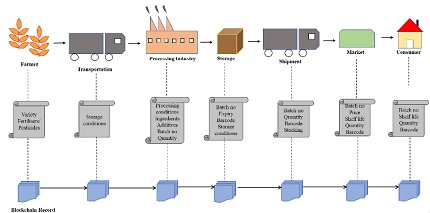
Fig.1 Block Chain and Traceability in Food Supply Chain
Blockchain Technology is not a single technology, but uses a group of technologies available in the computer and information technologies that have commercial applications. These component technologies include cryptographic hash functions, database technologies especially distributed databases, consensus algorithms, public/private key cryptography, and decentralised processing.
Some important aspects related to blockchain are (i) whether permission is needed to access the blockchain; (ii) how a new block is added to the blockchain; (iii) whether to use the blockchain as a virtual machine where programs representing business processes are run; and (iv) whether the consensus algorithm and smart contract operations depend on an artificial currency or not.
Application in Food Industry
Consider an example of application of blockchain model for meat where the parties involved are supplier, producer, distributor, retailer and customer. The supplier uploads data regarding the fodder or feed given to the animal and then it can be tagged with RFID which includes all the information such as species name, age and so on. Then, the producer gets all the necessary information and the products like cuts are prepared accordingly.
Now, the package used will have the QR code providing further information about the expiry date, storage conditions and so on. The distributor delivers the product to the retailer where it is kept for sale with all the essential data already stored in databases. After the consumer purchases the product, they can get insight about the origin, processing conditions, storage conditions of the particular product. Hence, trust is maintained between all the participating individuals in the supply chain as each one of them have all the data.
IBM announced a consortium with 10 major food suppliers to apply blockchain technology to the food supply chain to improve food safety issues. Walmart, Kroger, Tyson, Unilever and Nestle are some of the suppliers who have started to apply blockchain in the food supply chain. In 2017, Walmart has successfully completed two blockchain pilots: pork in China and mangoes in the America using IBM’s blockchain solution based on Hyperledger Fabric. With a farm-to-table approach, Walmart’s blockchain solution reduced time for tracking mango origins from seven days to 2.2 seconds and promoted greater transparency across Walmart’s food supply chain.
Conclusion
Thus, it can be concluded that BCT enhances the security, authenticity and transparency needed to trace and track the products. It allows the customers to retrieve the high-quality information required to make more informed choices. BCT also gives us a unique level of certainty over the trustworthiness of the information. With the application of BCT, products can be easily understood, checked and trusted as they move along the supply chain.
(Dr Venkatachalapathy is professor and head, Department of Food Engineering at Indian Institute of Food Processing Technology, Thanjavur. Pushparaj and Abhirami are research scholars at IIFPT. They can be contacted at venkat@iifpt.edu.in)
|
|
|
|
|
|
|
|
|
|