|
|
|
You can get e-magazine links on WhatsApp. Click here
|
|
|
|
|
|
A standalone UPF law to tackle the menace essential
|
|
Thursday, 05 March, 2026, 12 : 00 PM [IST]
|
|
Dr Lakshmi Menon
|
India is amidst a global food transition with dynamic yet concerning nutrition landscapes. The Indian thali is shifting from minimally processed, home cooked foods to ultra-processed, ready- to-eat foods built for speed, taste and repeat cravings. UPFs are a category of foods that undergo a series of industrial processes combined with classes of additives to ultimately appeal to its palatability. Overdependence on these ultra processed foods that are stripped of practically all nutritional values are at the helm of an alarming public health transition.
National and Family Health Survey-5 (2019-2021), India’s largest health survey gave this transition a clearer picture that obesity is a widespread concern across the length and breadth of the nation. Obesity in a public health showcase means greater risks of lifestyle & non- communicable diseases (NCDs) such as diabetes mellitus, cardiovascular disease, and hypertension. To reconfirm the transition, the National Household Consumption Expenditure Survey (2023-2024) states that a sizable share of nearly a tenth of the monthly income is spent on beverages, refreshments, and processed foods & cooked meals.
Dietary guidelines and food regulations are not far behind in catching up with the “trending” ultra processed food shift. The dietary guidelines for Indian populations by the Indian Council for Medical Research in 2024, clearly move beyond the cliché of “limit salty, sugary, fatty processed foods”. Guideline 15 in the Dietary Guidelines for Indians boldly proclaim ultra-processed (UPFs) and High Fat, Sugar & Salt (HFSS) foods as a daily risk in the modern food market.
Recognising the detrimental effects of UPFs, the Food Safety and Standards Authority of India (FSSAI) has been actively investigating ways to control the manufacture, distribution, and marketing of UPFs. The approach has been through regulations and draft proposals at three levels of intervention, clearer on-pack labelling, stricter rules on what brands can claim in ads, and front- of-pack nutrition labels to help shoppers judge products fast. Nevertheless, a standalone UPF law to tackle this dietary menace is the need of the hour.
The food industry that has made hay while the sun shines, fears serious setbacks if nutrition transition to UPFs is undone. The industry argues that tougher UPF rules could hit revenues and raise costs, especially if brands must reformulate popular products. It also warns that tighter regulations may reduce the range of low-cost foods that many consumers rely on. However, no justification by the food industry can undo the repercussions of UPF usage on poor health outcomes.
India has been a frontrunner to the finish line for leading nations in incidences of obesity, diabetes, hypertension, and cardiovascular diseases, affecting both urban and rural populations alike. Desi diets remain nutritionally inadequate with UPFs supplying a significant proportion of calories — often quoted at anywhere between 25–60% of total daily energy intake. There is no surprise that UPFs are at centre of the non-communicable disease debate owing to their obesogenic nature of high fats, sugar and salt.
The damage by UPFs is also via its impact on food structures. Over processing disrupts the natural food matrices making them easily digestible with higher glycaemic indices. This poses a risk to accelerating blood glucose levels which can cause metabolic instability & risks. The overuse of additives adds to the misery of poor metabolic outcomes. Evidence suggests that gut microbiota can be affected by this overindulgence with food additives causing an inflammatory disaster response. UPF consumption clustered with unhealthy behaviours presents a perfect myriad for metabolic diseases. Coupled with universal accessibility, taste and aggressive marketing strategies, UPFs could lead to a default setting for health doom in India.
Popkin and Ng (2022) proposed a stage wise nutrition transition (Figure 1) to offer an explanation to changing health environments in India and world over. It describes five stages through which societies tend to navigate: collecting food, facing famine, receding famine, nutrition-related chronic diseases, and finally behavioural change to hit the reset mode on poor health situations. In the earliest stage, diets depend on hunting and gathering, with high physical activity and low life expectancy. The famine stage reflects unstable food supply and widespread undernutrition as receding famine stage is met with improved food security and diet diversity. Rapid urbanisation and economic growth trigger a shift towards ultra-processed foods, and non-communicable diseases. The final stage represents growing awareness and efforts to improve diet and lifestyle and reduce dependence on foods out of a package. 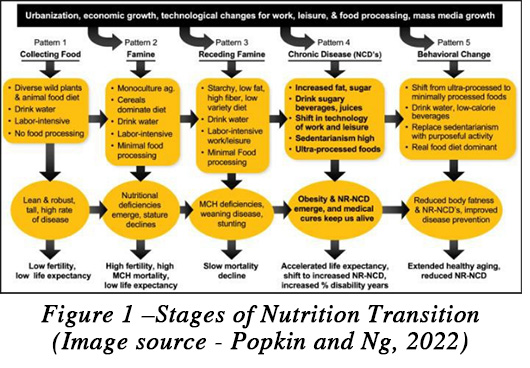 The optimism of this positive stage of nutritional transition is that they are a modifiable determinant of population health. The way forward will be through understanding UPFs and nutritional influences in India with large-scale cohort studies while resetting the dynamic food environment back to India’s rich traditional landscape. The article re-emphasises the need for stricter policy changes, focused educational initiatives, and stringent market regulations to promote healthier eating habits while reducing the dependence on UPFs and incidence of diet-related NCDs. (The author is assistant professor, Manjulaben Gunvantrai Shah Department of Post Graduate Studies in Clinical Nutrition and Dietetics. Dr BMN College of Home Science (Empowered Autonomous), Mumbai. She can be reached at menon.lakshmi85@gmail.com) |
|
|
|
|
|
|
|
|
|