|
|
|
You can get e-magazine links on WhatsApp. Click here
|
|
|
|
|
|
Kurien's passionate diary on Dairy
|
|
Saturday, 19 November, 2005, 08 : 00 AM [IST]
|
|
P N V Nair
|
If we depend — as we have too long depended — on bureaucrats and politicians and not on our people to deliver the goods, then there is little that we will achieve as a nation
A man with a rare vision, Dr Verghese Kurien has devoted a lifetime to realising his dream - empowering the farmers, and rural women especially. At 83, the Father of India's White Revolution, in his memoirs titled "I too had a dream," recounts, in his characteristic frank and no-nonsense style, how he shaped the dairy industry in India, which has now become the largest producer of milk in the world. Ratan N Tata, in his Foreword, rightly sums up the life and contributions of this multi-faceted personality.
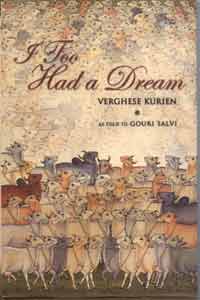
"Dr Kurien's involvement with dairy engineering was a twist of fate. He would normally have pursued science or engineering (metallurgy). What he, therefore, did for the dairy industry in India is truly amazing. One cannot help but wonder what India would be today if we had a thousand Dr Kuriens with this type of vision and with similar commitment, dedication and national spirit."
It was one of the treasured moments in his life when India's first Prime Minister Jawaharlal Nehru once embraced him and said, "Kurien, I am glad that our country has people like you - people who will go ahead and achieve that which seems unachievable."
No wonder, Kurien was inspired in his early career by illustrious leaders like Sardar Patel, Morarji Desai and Tribhuvandas Patel that forced him to make Anand his future home, engineering the milk cooperative movement in India. His association with Patel had convinced him that the way to address the problems of the rural poor was to build institutions that would cater to their needs. Milk cooperative was the answer for the dairy sector where the farmers could control procuring, processing and marketing of milk and increase their income.
The cooperative movement has been his religion ever since, and Dr Kurien could even become a fanatic to defend the role of cooperatives in India's economic growth and rural development. Says he: "Unfortunately, we forgot that the biggest asset of India is its people. Any sensible government must learn to unleash the energy of its people and get them to perform instead of trying to get a bureaucracy to perform." This more or less explains why he himself did not continue with a government job in the dairy department and opted for the Kaira Milk Cooperative under Tribhuvandas Patel at Anand. He also opted to remain an employee of the farmers all his life. And the maximum salary he drew was Rs 5,000 as the Chairman and General Manager of GCMMF.
"From the very first day at Anand, working for the cooperatives was an act of faith for me. As I see it, faith is belief without reason. For those who believe, no explanation is necessary. For those who do not, no explanation is possible," writes Kurien, who is the nephew of one of the most popular Finance Ministers if India, John Mathai.
The Anand pattern of cooperative, better known as Amul, was so successful that at the request of Lal Bahadur Shastri, when he was the Prime Minister, Dr Kurien set up the National Dairy Development Board (NDDB) to replicate it across India. He also established the Gujarat Cooperative Milk Marketing Federation (GCMMF), which he heads even now, to market Amul products. GCMMF has touched a turnover of Rs 3,000 crore, including exports worth Rs 200 crore.
Operation Flood made the country self-sufficient in milk and this was achieved entirely through the cooperative movement. Today 11 million farmers in 24 states own 200 dairy plants handling 18 million litres of milk a day.
A man of principle, Dr Kurien is a fighter, and that landed him in several controversies involving politicians and bureaucrats.
"We at NDDB - and at Amul before that - always insisted on our autonomy, which we have never allowed anyone to violate." But he feels proud to say that he had survived all those battles. He recalls how Indira Gandhi had intervened when he had some problems with Union Agriculture Minister Rao Birendra Singh and Food & Agriculture Minister Jagjivan Ram. In both incidents, Mrs Gandhi sent personal notes asking them, "Don't do this. Leave him (Dr Kurien) alone."
He had a dislike for the bureaucrats and that perhaps explains why he had to fight with them quite often. "Our bureaucracy is too bloated and therefore it is burdensome. For example, 95% of the agriculture budget goes into paying the staff's salaries and I would not be surprised if the remaining 5% goes towards the maintenance of their jeeps. Where is the planning in that?"
"If we depend - as we have too long depended - on bureaucrats and politicians and not on our people to deliver the goods, then there is little that we will achieve as a nation … I am convinced that the IAS, in its present form, will have to be abolished sooner or later. There is no other solution."
Often he had been accused of being autocratic. "Perhaps there were times in my career when I was, yet it was always as a response to a situation. If the situation demanded autocracy, I gave it autocracy. But never once did I let go of the larger vision and mission. The vision was that of democracy at the grass-roots and the mission one of placing the tools of development firmly in the hands of the dairy farmers," Dr Kurien says.
Bold and outspoken, all's not well with Dr Kurien's association with NDDB which is now headed by his protégé Ms Amrita Patel, the daughter of a former Union Finance Minister, H M Patel. He has also some problems at the Institute of Rural Management, Anand (IRMA), which is again his dream project. This is because Dr Kurien would not compromise on his principles.
Dr Kurien is the recipient of more than 150 national and international awards, including the Ramon Magsaysay Award for Community Leadership (1963), Wateler Peace Prize (1986), World Food Prize (1989), Padma Shri (1965), Padma Bhushan (1966) and Padma Vibhushan (1999). But he expresses his anguish that "recognition from my own country for the work I had done came only after I received international acclaim." However, the three Padma awards occupy the pride of place in his home today, though he misses the highest national civilian award, the Bharat. All other awards had been given for display at the Amul Museum which was recently set up in his old house in the dairy complex.
In conclusion, Dr Kurien writes. "My unfinished dream will only be accomplished when the farmers of India have a level-playing field to compete with other forms of businesses. There are some who always try to find fault with the cooperatives. My question to them is: Has democracy in India worked as it should have? If not, is it the fault of democracy as a system, or does the fault lie in us? Similarly, I believe, cooperatives have not failed…If cooperatives have failed, it is because they have, so far, not been given a level-playing field and because they have not been run as true cooperatives."
- Verghese Kurien
As told to Gouri Salvi Lotus Collection, Roli Books
|
|
|
|
|
|
|
|
|
|